What should we do when everything falls apart?
I think our education system is missing one of the most important lessons in life: how to cope with disappointment. They teach us how to dream big and strive for success, but not how to change course when life doesn’t go according to plan. It’s easy to say, “Never give up!” or “You can do anything!” or “If so-and-so achieved it, so can you.”
Yes, you can keep trying until you achieve your dream—IF you have endless youth, financial stability, and a supportive environment.
But that’s not always the case.
In fact, it’s rarely the case.
At some point, you have to face reality.
On June 4, 2011, I was facing the reality that I had to return to Japan after spending two years pursuing my dream in the United States. Technically, I had already left the U.S.—I was in Capilano Suspension Bridge Park in Vancouver.
It was a cloudy day. I was walking along a wooden boardwalk overlooking the gorge. There weren’t many people on the trail. I felt relieved. For someone with a wounded heart, it was too painful to see couples, families, or groups of young students. Everyone seemed happy, successful, full of promise. They reminded me of the person I had dreamed of becoming.
What a huge gap between them and where I was now.
It was far wider than the suspension bridge itself.
And my side of the bridge had already collapsed.
No job offer.
No marriage proposal.
No savings.
No dream.
I had hoped to find a job, meet a partner, and build a life in New York.
None of it happened.
Or rather, I couldn’t make it happen.
I had tried everything I could, yet it wasn’t enough.
Or perhaps my plan had been unrealistic from the beginning.
If I had been richer, younger, or smarter… would things have turned out differently?
One word: Setback.
I crossed the suspension bridge and arrived at the Treetops Adventure. It had started to drizzle. I sat on a bench built around the trunk of a giant tree. When I leaned back, I could see its top disappearing high above me. It was so tall that I almost lost my sense of scale.
“These trees have been here for hundreds of years,” I thought.
Then I thought about my own twenty-nine years. Raindrops kept falling on my face. I wanted to cry, but no tears came. It felt as though I had used up all my strength. Even my tears were gone.
“Loser,” I whispered to myself.
I didn’t know what to do next. I didn’t want to go back to Japan. What now?
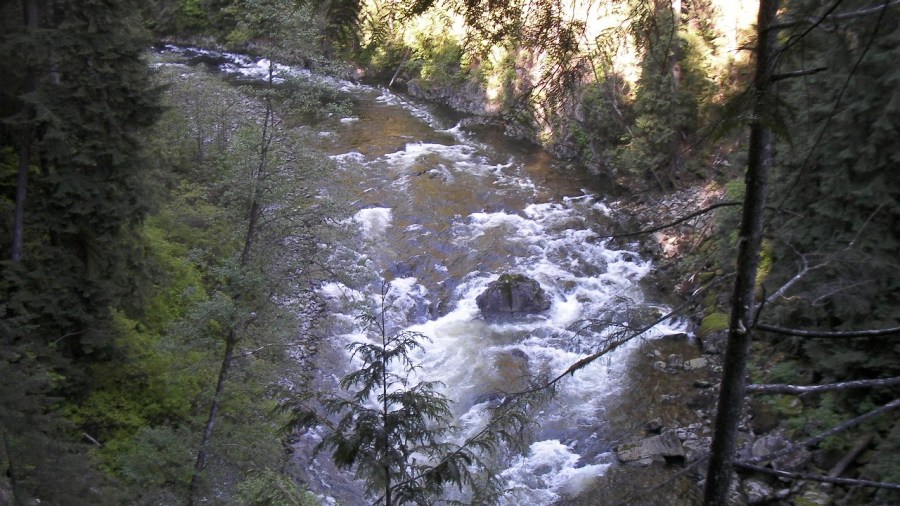
I stood up and walked toward the Cliffwalk. The water below was crystal clear. I imagined jumping from the platform.
It seemed so easy. Just climb over the railing… and step off.
The only reason I didn’t do it was because I didn’t want to ruin such a beautiful place. Somehow, it felt wrong to drown in self-pity in scenery like this. Did Mother Nature care who I was? No.
It seemed absurd to stain this place with my blood and flesh. Perhaps the bears would appreciate it. The park rangers probably wouldn’t.
“I’m still alive,” I thought.
My eyes could still see the stream.
My feet were still planted on the deck.
My heart was still beating.
“Maybe there’s something I can still do with that.”
I took a deep breath. I hoped it would help me find something—anything—to hold onto.
A new goal.
A different path.
An epiphany.
Hope.
But nothing came.
I just stood there in the rain, listening to the sound of the rushing water, alone and numb.
Fifteen years later, I’m writing this piece in a private library in Kyoto.
It’s a sunny, 30-degree day.
I’ve just finished a cup of tea.
Over the past fifteen years, I have experienced disappointment, failure, rejection, loneliness, frustration, futility, humiliation, shame, and almost every painful emotion that comes with being alive.
But none of them has been as devastating as what I felt beneath those trees.
At least now, if I ever walk into a forest again, I’ll bring a bear bell.
 A Thousand Years