
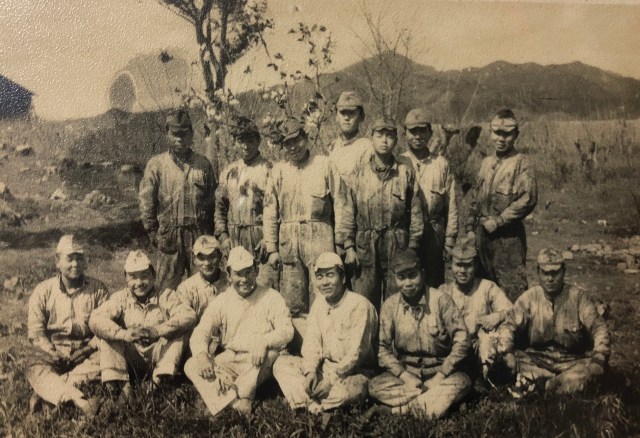
Recently, while I was looking for some documents, I happened to discover my late grandfather’s memoir about World War II written in 1983. He served as an aviation engineer for the Imperial Japanese Navy during the war. Below is an English translation of his handwritten notes. I changed the original Japanese calendar (Showa Era) dates to the Gregorian calendar for convenience.
October 1939:
Joined the Imperial Navy Service. Assigned to Yokosuka Navy Air Group as a member of the first Reserve Trainee.
After the training, I was appointed to the Maintenance Section as a Reserve Seaman Apprentice. Then I was advanced to Reserve Petty Officer 3rd Class.
November 1940:
Discharged. Became a reserve officer.
Received a certificate for Aviation Engineer Technician: No. 614.
October 1st, 1941:
Got a call-up and joined to Kasumigaura Navy Air Group.
Soon after I got transferred to Tsukuba Navy Air Group as an instructor.
May 1942:
Transferred to the 1st Air Group No. 752 troop.
Took a separate flight to Wake Island, Kwajalein Atoll, Roi-Namur Island and then arrived at Taroa Island. (Maloelap Atoll, South Pacific)
In Taroa, I had a monkey. Whenever I stuck my head in front of him, he would try to pick up lice off my hair as if he was fawning upon me. He seemed to have a better ability to understand pecking orders than soldiers.
November 1942:
Transferred to Chitose Air Group.
Had a stopover at Kisarazu Air Group.
Enjoyed a drinking spree in Kisarazu.
May 1943:
Sent to The Kuril Islands as a member of the Paramushir Expeditionary Squad.
In Paramushir Island, I saw salmons going upstream to spawn. They swarmed in the river and made the water level look higher. It somehow reminded me of the fact that pilots who crashed in the water would be dead in around 5 minutes.
As I was craving for some greens I ate grass on the seashore which looked like small chickweed.
Every day, every meal, we ate fish. There was nothing else but fish. Salmon, trout, cod, fish eggs, flatfish. When I went into the water wearing my boots, flatfish crawled under the soles as they were attracted by the body heat.
Clams were good food. We were supplied with vitamin C tablets, but we didn’t need such things at all as long as we could get fresh fish and clams.
October 1943:
Returned to Chitose Air Group.
Hung out in Sapporo. Visited Tanaka’s place.
September 1944:
Transferred to Jinmachi Air Group in Yamagata.
Hung out in Yamagata city, Jinmachi, Tenryu hot spring, Higashine, etc.
(Editor’s note: Nearly a year past before his next entry.)
August 1945:
Returned home as the war came to an end. Learned that my younger sister, Suzuko, had died earlier because of malnutrition. Maybe her body couldn’t endure the plight of wartime. Or had she worked too hard? Telephone operator must have been a hard job during the war.
At Yokosuka Navy Base:
During the drill for the land fighting, I saw a mid-air disintegration of the prototype of a Zero-fighter aircraft. I used to work in the airframe design division of Kawanishi Aircraft Company. I would sketch rough blueprints and calculate section modules. I developed an interest in vibrations and the acceleration of gravity. So I was deeply stirred to have witnessed the free-falling of the wings and the fuselage at different speeds. It was a clear demonstration of the theory of hydrodynamics.
At Wake Island:
When I landed on the island I saw some crane trucks, scraper trucks and bulldozers which Americans have left behind. I was really impressed to see the power and advancement of the technology: the machine civilization.
In the outside laundry area of the barracks, a woman’s underwear was still hanging from the dryer rack. Its strikingly vivid colour was unforgettable.
Looking back from now, I think Americans were very free-spirited even in the midst of the war.
I cannot remember my grandfather ever talking about the war. All I knew was the fact that he was an aircraft mechanic during the war. I have been wondering for a long time what he had seen on the battlefield. So I cherished this memoir as a surprise gift for me.
After I read his text I came to realize why my grandfather liked to travel so much. He travelled to a lot of places around the world. But he didn’t really go to popular tourist destinations such as Paris or New York. He was interested in ancient civilizations. So he visited Palmyra, Cairo, Dunhuang, Teotihuacan, etc. And he collected weird artifacts from those historic cities. I think he wanted to understand the karma of civilization and war.
I imagined a young man who was standing on an island, looking up to the sky.
 A Thousand Years